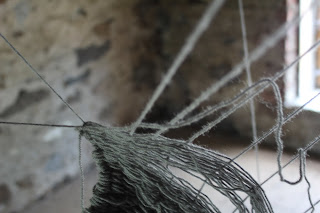
Weave.
I brought the weaved grey piece back to NI from Hungary, because I wanted to explore the possibilities of hanging it in this space, which is an old hay loft at my family home. I wanted to see if displaying it without a person could incite the warm feelings of humanness only through the grey weave and loose ends occupying a space. However, I think the garment-like quality of the soft material obviously lends itself to being worn, but what was significant about the wearers of the weave initially, is that they were involved in the process of making it, or they were present (in Budapest) at the time it was being made. This piece is another of my recent works that seem to physically represent a process, a time and a situation, and be a record of these things.
Hay Loft.
When I was deciding where to go when I returned from Budapest, Glasgow or Belfast, one of the things that encouraged me to go home was this space at my house in NI. The loft used to filled to the roof with hay for horses. In September I think, we would get hundreds of hay bales delivered, and my parents and young farmhands would have a system where they passed bales up the steps to the loft. I remember being too weak to help, and also finding it amazing that this huge space could be filled so quickly. It was our new playground. We had to wait till a few bales had been used before we could start moving them about, but my brothers and I had the best castles, forts and dens, especially good for when it was raining outside. Thinking back, there were dangers of suffocation and falling.
In one year, the loft would be empty again. There would be some bales in the bottom corners that had gone mouldy with the dampness of the old building. The loft floor would be full of loose hay. Sometimes there was also straw. straw was for the horses' beds, hay was for their food.


Fred Sandback.
I was looking at Fred Sandback a lot recently and I really liked the way he spoke about his sculptures:
A sculpture made with just a few lines may seem very purist or geometrical at first. My work isn’t either of these things. My lines aren’t distillations or refinements of anything. They are simple facts, issues of my activity that don’t represent anything beyond themselves. My pieces are offered as concrete, literal situations, and not as indications of any other sort or order...
This text was first published in English and Flemish in
Plan & Space, exh. cat. (Gent: Koninklijke Academie, 1977).
...Early on, though, I left the model of such discrete sculptural volumes for a sculpture which became less of a thing-in-itself, more of a diffuse interface between myself, my environment, and others peopling that environment, built of thin lines that left enough room to move through and around. Still sculpture, though less dense, with an ambivalence between exterior and interior. A drawing that is habitable....
This text was written in November 1998 and first published inHere and Now: Fred Sandback, (Leeds: Henry Moore Institute, 1999).
Knitting yarn is great for making the proportions, intervals, and shapes that build the places I want to see and to be in. It’s like a box of colored pencils, only I can use it to make a three-dimensional sculpture instead of making a drawing on paper.
This text was published in Children’s Guide to Seeing. Fred Sandback: Sculpture, (Houston: Contemporary Arts Museum, 1989).
Open Doors.